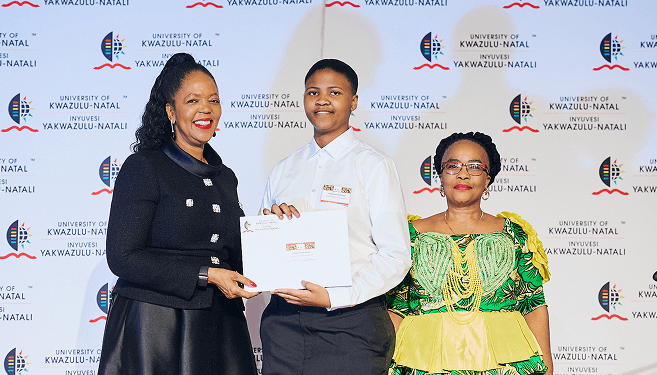
Ms Kiara Motheelal’s academic journey has been defined by excellence, culminating in her being awarded a Bachelor of Science in Engineering (Civil Engineering) summa cum laude from the University of KwaZulu-Natal (UKZN).
“Graduating signifies the successful completion of a challenging yet rewarding journey,” Motheelal said. “It required dedication, problem-solving and many sleepless nights, but it has been deeply fulfilling.”
She says the experience has tested her resilience as well as cultivated her ability to think critically and approach real-world engineering challenges with confidence.
Choosing UKZN was a no-problem decision, considering the Institution’s strong reputation for Engineering excellence and its commitment to producing well-rounded graduates. Completing both her undergraduate degrees and advanced academic work at the University helped make it a seamless transition from academia to industry.
Currently working as a graduate civil engineer in the water department at Ingérop South Africa, Motheelal has already found a slot in industry where she is gaining practical experience in water and wastewater infrastructure projects, bridging the gap between academic knowledge and real-world application.
Graduating summa cum laude, Motheelal developed a strong academic foundation and discovered a passion for both structural and water engineering. Her interests in water quality, wastewater treatment and sustainable infrastructure ultimately shaped a clear and purposeful career trajectory.
In the final year of her undergraduate Engineering degree, her academic work took on a practical and impactful dimension through both a design project and a dissertation.
Her design project focused on creating a decentralised wastewater treatment plant for the UKZN campus. This innovative system aimed to reduce pressure on existing infrastructure while promoting sustainable wastewater management. Importantly, it also serves as an educational tool for future Engineering students.
For her dissertation, Motheelal explored how mathematical models can be used to predict river water quality. Alongside this, she developed a chemical costing model to estimate how water quality affects treatment costs. Her research demonstrates how monitoring water quality can help treatment facilities make better, more cost-effective decisions.
Motheelal’s motivation to specialise in water engineering stems from the pressing challenges facing South Africa. Issues such as pollution, ageing infrastructure and increasing water demand highlight the urgent need for sustainable and innovative solutions.
“Water is a critical resource,” she said. “I wanted to contribute to an area where I could make a meaningful difference.”
The impact of Motheelal’s work extends beyond the classroom. Both her design project and dissertation contribute to improving water and wastewater management by promoting sustainable treatment solutions, reducing strain on infrastructure and supporting informed decision-making.
Ultimately, these efforts play a role in improving water quality, reducing operational costs and protecting the environment, key priorities for South Africa’s future.
Her goals are clear: to become a professionally registered engineer (Pr Eng), specialise further in water and wastewater engineering with continued involvement in structural engineering and contribute meaningfully to sustainable infrastructure development across South Africa.
Motheelal thanked her supervisor, Professor Muthukrishnavellaisamy Kumarasamy, for his guidance during her final year project; her parents, Dr Prineetha Naidoo and Mr Amrith Motheelal, for their unwavering support and sacrifices; and her partner, Mr Ruché Ramlucken.
Words: Swasti Maney
Photograph: Sethu Dlamini