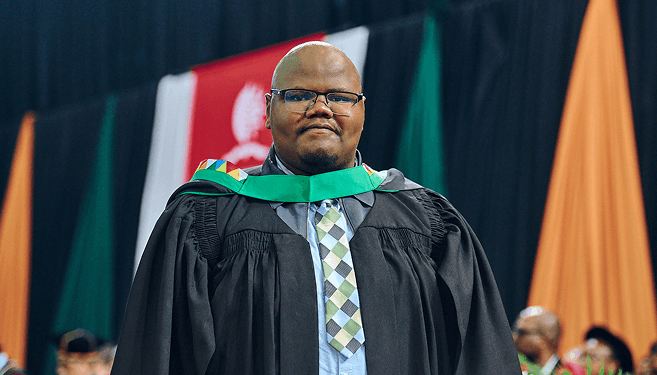
Industry experience and a growing interest in water sustainability is what motivated Mr Thabiso Zondi to complete a Master of Science in Engineering (Chemical Engineering) at the University of KwaZulu-Natal (UKZN).
“Working in industry exposed me to real engineering challenges and made me want to understand these systems at a deeper level,” he said. “UKZN allowed me to combine academic research with practical industrial problems, which was exactly what I was looking for.”
Zondi’s research, titled: ‘Simulation and Optimisation of Direct-Chill (DC) Aluminium Ingot Casting Cooling-Water Systems for Enhanced Cooling and Water Efficiency’, examined how industrial cooling water systems could be made more efficient and more circular.
Zondi was supervised by Professor Amir H Mohammadi.
Using aluminium casting as a case study, Zondi examined a process in which large volumes of water are used to remove heat from cast metal before being cooled and recirculated. His focus was on keeping water in industrial systems for longer, reducing unnecessary losses and recovering more of it rather than treating water as a once-through resource.
Zondi’s interest in the area was strongly influenced by his industry experience and South Africa’s water challenges. “Working in industry made me realise how easily water can become something we simply expect to be available. In South Africa, that is a dangerous assumption,” he said.
He became interested in how engineering could help industry continue to grow while using water more responsibly, drawing him towards water circularity and the challenge of designing systems that do more with less.
Zondi believes the significance of his research lies in changing how production and sustainability are viewed. “There has traditionally been a tendency to separate production and sustainability,” he said. “I think there is an opportunity to change that.”
For him, sustainability should be incorporated into the engineering of the process itself. “Understanding industrial systems properly could help engineers consider whether water could be circulated for longer, losses reduced, wastewater turned into a resource and heat recovered, while operating more sustainably could also make processes more resilient and efficient,” he said.
His research has also shaped his future research interests.
One of his key findings was that improving process efficiency did not always mean reducing water losses. In cooling systems, much of that loss was still tied to evaporation, which remained a significant challenge in industry.
“That finding has stayed with me,” he said. “It has made me want to move beyond optimisation alone and start thinking about what new technologies we may need to solve the losses that existing systems cannot.”
His next question, therefore, was how evaporative water losses could be recovered, reduced or rethought at scale. He hopes to explore the problem further, develop solutions and ultimately invent technologies around it.
Zondi credited his family, friends, colleagues, supervisor, mentors and industry experts for supporting his journey.
“I often think of myself as a mosaic of all the people who have supported, cared for, loved, validated and assured me along the way,” he said. “Ngiyabonga kakhulu. Ngaphandle kwenu, lo msebenzi ubungeke uphumelele.” (“Thank you so much. Without you, this work would not have succeeded.”)
With his MSc completed, Zondi looks forward to reading more, attending live music shows and spending time with the people he cares about.
Graduation has also prompted reflection on what engineering means to him: “Initially I thought it was mainly about processes, calculations, equipment and financial rewards. Over time, I’ve come to see engineering as much more than that. It is really about solving problems that matter and making better choices about how we use the resources around us.
“The future of engineering is about making systems work better for people, industry and the environment,” he said.
Words: Sally Frost
Photograph: Sethu Dlamini