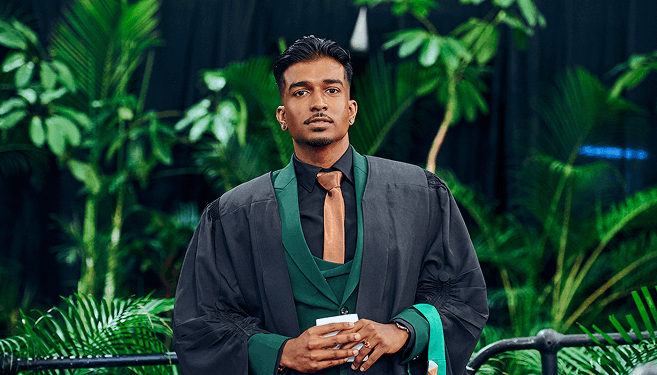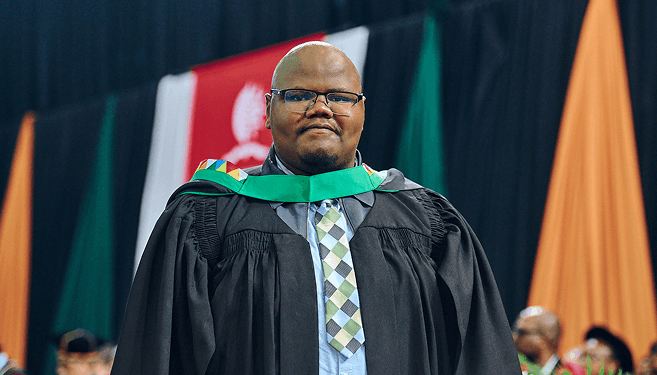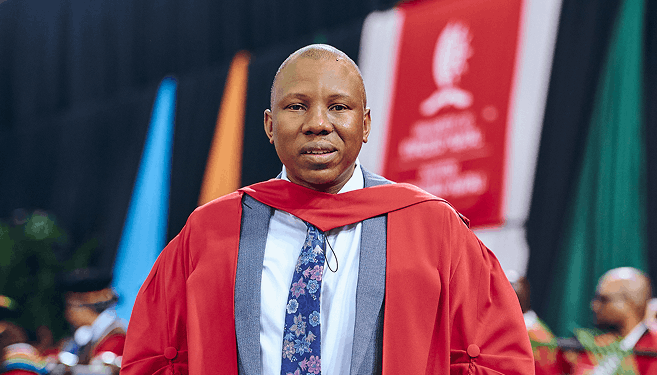
For Dr Emmanuel Zikhonjwa, graduating with a PhD in Engineering (Chemical Engineering) from the University of KwaZulu-Natal (UKZN) is the fulfilment of a dream that began years ago.
Zikhonjwa had initially planned to study Chemical Engineering at UKZN as an undergraduate, but financial constraints forced him to take a different route.
He began at Mangosuthu University of Technology, where he completed a diploma, before moving to the Durban University of Technology, where he secured his Bachelor’s and a Master of Engineering degree in Chemical Engineering.
“Returning to UKZN to pursue my PhD was much more than simply obtaining another qualification. It represented the fulfilment of a long-held dream and, for me, one of the greatest achievements of my academic journey,” said Zikhonjwa.
Zikhonjwa grew up in Matikulu Bridge, Mandeni, a rural area where schools and communities often had limited resources and exposure to opportunities available in more advantaged environments.
But he refused to let his circumstances dictate his future.
“My background was part of my story, but it was never going to determine the ending,” he said.
His doctoral research, supervised by Professor David Lokhat and co-supervised by Professor Milan Carsky, was titled: ‘Development of Biochar from Marine Macroalgae and Mushroom Waste’. It explored the conversion of biomass waste into value-added biochar via pyrolysis.
Agricultural and biological waste, including plant residues, mushroom waste and marine macroalgae, are increasingly recognised as valuable renewable feedstock because of their carbon-rich composition. Zikhonjwa investigated the production of biochar from a mixture of terrestrial biomass, specifically mushroom waste, and marine macroalgae through oxygen-limited pyrolysis.
Slow pyrolysis of the biomass was conducted at a constant heating rate of 15.0degC/min at temperatures of 500degC, 600degC, 700degC and 800degC.
His study focused on understanding how pyrolysis conditions influence the properties and potential applications of the resulting biochar, including how its physicochemical characteristics change with pyrolysis temperature and how these characteristics influence its potential performance as a soil amendment.
The research also evaluated the potential of the produced biochar for agricultural applications and explored how waste materials can be transformed from environmental burdens into useful resources.
Zikhonjwa hopes the work will ultimately contribute to scalable technologies that move beyond the laboratory into practical industrial applications, with future research continuing to investigate the optimisation, economic feasibility, environmental performance and large-scale application of algae- and mushroom-based biochar.
His degree has been about more than research, however: “A PhD is a profound educational experience. It teaches patience, critical thinking, discipline, independence, problem-solving and resilience. It also reminds us that learning never truly ends,” he said.
His experience has reinforced his belief in lifelong learning and has prepared him for a continuing career in academia, where he hopes to contribute to research, mentor students and collaborate with industry and other research institutions.
Zikhonjwa serves as a junior pastor at Soul’s Harbour Ministry in KwaNdengezi, Mariannhill, while balancing his academic responsibilities with his role as a husband. He credits his faith with sustaining him through periods of exhaustion, uncertainty and frustration. “Throughout this journey, I thank God, whose grace and strength have sustained me.”
He thanked his supervisors, the University, laboratory staff Ms Xolisile Hadebe and Ms Thobekile Mofekeng, his wife Ms Nokwanda Zikhonjwa, mother Ms Nobuhle Ncube, spiritual father Dr Bishop Samuel P Ndlovu, friends and everyone who supported him.
He also reserved thanks for himself – for continuing through the difficult days and refusing to abandon his goal.
“I am proud of the persistence, courage, discipline and commitment that I brought to this journey,” he said. “The journey may be difficult, but difficulty does not mean impossibility.
“Never allow your starting point to determine your destination. Keep learning. Keep believing. Keep working. Keep showing up.
“And above all, never give up on the dream.”
Words: Sally Frost
Photograph: Sethu Dlamini