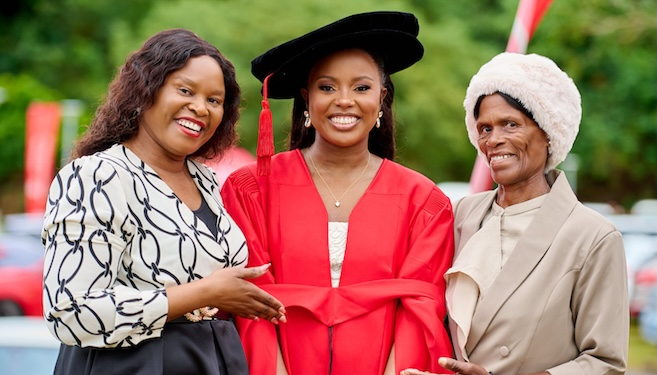
Dr Silindile Gumede, who was awarded a PhD in Engineering (Chemical Engineering) from the University of KwaZulu-Natal (UKZN), selected the Institution as her doctoral home because of its excellent reputation in education and research.
Gumede’s journey, however, has not been without difficulty.
When she first arrived at UKZN as an undergraduate Engineering student, Gumede – from the rural area of Mtubatuba where there was no electricity or water at that time – struggled to adjust both academically and socially.
Students from such backgrounds often face gaps in prior preparation, limited resources, and unfamiliar systems, she explained. These challenges led to her academic exclusion.
“At the time, it felt like the end of my journey in Chemical Engineering,” she said. Unwilling to wait a year to return, she enrolled at the Durban University of Technology (DUT), keeping the full truth from her family. “Coming from being a top student in my district, I was ashamed and felt like I had disappointed them,” she reflected.
At DUT, Gumede rebuilt her confidence and excelled, completing both her undergraduate and Master of Engineering degrees with distinction.
“Returning to UKZN for my PhD was more than just an academic goal; it was a full-circle moment of growth and perseverance,” she said.
Her personal journey has shaped her current approach as a lecturer at DUT, instilling compassion and understanding for students navigating their own challenges.
Gumede’s doctoral research, titled: ‘Recovery of Valuable Metals from Spent FCC [Fluid Catalytic Cracking] Catalysts Using Leaching Extraction Technique’, focused on recovering valuable metals from waste materials, specifically spent refinery catalysts. These catalysts are used in refineries to accelerate chemical reactions that convert crude oil into useful products like petrol and diesel. Over time, they lose their effectiveness and are discarded as waste; however, these materials contain valuable metals such as vanadium and nickel, which are in high demand globally.
Using a process called leaching extraction, Gumede developed ways to safely extract vanadium and nickel from this waste. “In simple terms, I’m turning industrial waste into valuable resources,” she explained. “This not only reduces environmental pollution, but also helps conserve natural resources and contributes to advancing cleaner and more sustainable energy solutions.”
Her interest in this field was rooted in her earlier work during her Master of Engineering research, where she focused on wastewater treatment and the removal of heavy metals from acid mine drainage. That experience sparked a passion for practical environmental solutions. When she approached her PhD supervisor, Professor Amir H Mohammadi, and her co-supervisor, Dr Mbuyu Ntunka, she shared her background and interests, and together they identified this research area as a natural fit. “It strongly resonated with me because it contributes to sustainable resource recovery,” she said.
The significance of Gumede’s research lies in its dual contribution to environmental protection and economic development. The extraction of metals from spent catalysts represents a strategic approach to meeting a portion of the demand for these valuable materials, which are essential for technologies such as renewable energy systems and electronics, while the process contributes to reducing environmental impact upon disposal by applying the principles of a circular economy, where waste is reused, and helps address global challenges related to resource scarcity and sustainability.
Looking ahead, Gumede plans to continue her career in academia as both a researcher and lecturer. She hopes to expand her work into scalable industrial applications and to collaborate with industry to implement sustainable technologies.
Central to her success was the unwavering support of her mother, who, despite having no educational background, prioritised education and made significant sacrifices. “Her belief in me laid the foundation for everything I have achieved, and she remains my greatest source of inspiration,” Gumede said, adding that her mother never misses an opportunity to celebrate her achievements.
As a mother herself of two sons, Gumede had to balance the demands of a PhD with mothering duties and maintained her physical and mental well-being through gym sessions and running. “Those moments gave me space to reset, stay focused and keep going despite the challenges,” she said.
“I would like my story to serve as a reminder that setbacks are not the end of the journey,” said Gumede. “You will encounter the most difficult moments of your life, but they may become a turning point and teach you resilience.”
Words: Sally Frost
Photograph: Sethu Dlamini