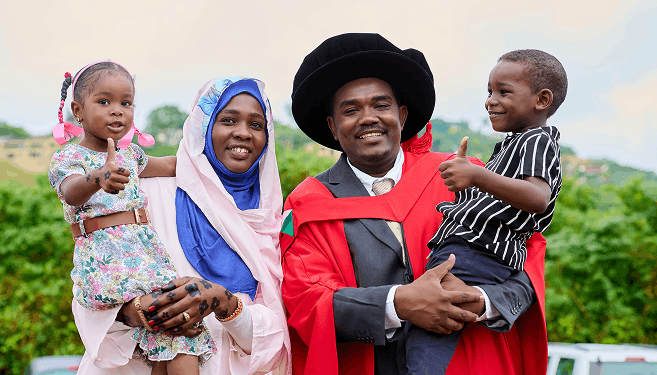
Graduating with a Doctor of Philosophy in Computer Engineering from the University of KwaZulu-Natal (UKZN) is far more than a ceremonial celebration, says Dr Mortda Adam, it is the culmination of years of perseverance, sacrifice and unwavering determination.
“Graduating is the moment to look around and realise a major milestone is complete,” Adam reflects. “It represents a deep, heavy experience in my field where I have made a genuine contribution to the community.”
That sense of accomplishment is hard-earned. He recalls the many difficult mornings when exhaustion weighed heavily, yet he pressed forward, driven by a clear goal. “Even though the path was hard, challenging and costly, I chose to keep going… and raise the winner’s flag.”
Originally from Sudan, Adam began his academic journey with a Bachelor of Science in Computer Science from Omdurman Islamic University, followed by a master’s degree at Sudan University of Science and Technology. His early career as a lecturer proved transformative. Teaching computer technologies gave him a broad and insightful perspective on the rapidly evolving tech landscape, sparking a desire to pursue deeper, specialised research.
This passion ultimately led him to UKZN, an institution he chose for its strong academic reputation and global research contributions. There, Adam immersed himself in cutting-edge fields such as computer vision, deep learning and real-time object detection; areas that would shape both his doctoral research and his long-term vision.
At the heart of Adam’s PhD, titled: ‘Deep Learning Approach for Object Detection on the Road for Edge Devices’, is a practical challenge with global implications: how to help computers ‘see’ and understand road environments more effectively. His research focuses on improving artificial intelligence systems that detect objects such as vehicles and pedestrians in real time; technology that underpins autonomous driving and advanced traffic monitoring systems.
“I worked on making these systems both accurate and fast, but also lightweight enough to run on devices with limited computing power,” he said. Many existing models are powerful but too slow or resource-heavy for real-world use, particularly in environments with constrained infrastructure. To address this, Adam enhanced a well-known detection model, introducing innovative, efficient techniques, including a newly developed attention mechanism, to improve performance without increasing computational cost.
The result is a significant step forward: smarter, faster and more efficient object detection systems that can operate effectively even on low-cost hardware. This has far-reaching implications, particularly for developing regions.
Adam’s motivation is deeply rooted in real-world concerns. Witnessing the widespread challenges of traffic congestion and road accidents inspired him to pursue research that could make a tangible difference. “These issues have serious consequences such as loss of lives, wasted time, economic costs and environmental pollution,” he said. “I wanted to contribute to solutions that improve road safety and transportation efficiency.”
His work does exactly that. By enabling more accessible and efficient intelligent systems, his research supports advancements in driver assistance technologies, autonomous vehicles and smart city infrastructure. In practical terms, this could mean earlier detection of hazards, improved traffic flow and better decision-making systems, ultimately helping to save lives and reduce environmental impact.
Currently working as a lecturer, researcher and software engineer, Adam continues to bridge the gap between academic theory and real-world application. His future aspirations are firmly focused on developing scalable, cost-effective technologies that can be widely adopted, particularly in resource-constrained environments.
“I want to design systems that are not only innovative but also affordable and deployable,” he said. “The goal is to support safer, smarter and more sustainable cities in Africa and globally.”
Adam credited his supervisors and mentors for their guidance and thanked his parents, whose values shaped his path. He also highlighted the unwavering encouragement of his wife, children, friends and colleagues.
Beyond academia, Adam finds balance in simple but meaningful pursuits. Long walks and swimming provide him with clarity and help maintain a healthy equilibrium between his professional and personal life.
Grounding his journey is a philosophy that continues to guide him forward: Focus on what must be done, regardless of circumstances or comparison to others. “I always ask what I can do better to reach my goals because I believe that what the mind believes, it can achieve.”
Words: Swasti Maney
Photograph: Sethu Dlamini